How Much Does Fuel Weigh? Petrol, Diesel, Jet Fuel & LPG Guide
Compare the weights of petrol, diesel, jet A-1, kerosene, and LPG per litre and gallon in kg and lbs. Includes fuel density tables and tank calculations.
Read articleWater (4°C) weighs 1 kg per litre. Convert litres to kilograms (and back) using its exact density.
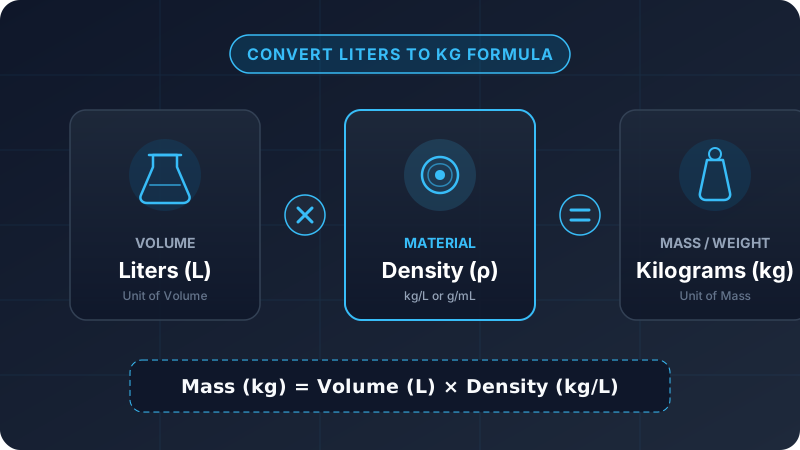
1 liter of Water (4°C) weighs approximately 1 kilograms (or 1000 grams) at standard room temperature. Because mass equals volume multiplied by density (\(m = V \times \rho\)), multiplying volume in liters by 1 gives the exact mass in kg.
Water (4°C) has a density of 1 kg/L, which makes it essentially the same weight as water. Pure water at 4°C is the reference point of the metric system: the kilogram was originally defined as the mass of one litre of it. That is why 1 L = 1 kg is such a durable rule of thumb, and why every other liquid is described relative to it.
Aquarium and water-tank sizing, swimming pool and rainwater-butt loads, shipping bottled water, and checking how much a full jerry can weighs before you lift it.
Water is densest at 4°C. Warming it to 20°C drops the density to 0.998 kg/L, and at 80°C it is only about 0.972 kg/L, so hot-water systems hold slightly less mass per litre than cold ones.
The density of pure liquid water reaches its physical maximum of exactly 1.0000 kg/L (1,000 kg/m³ or 62.43 lb/cu ft) at precisely 3.984°C (commonly standardized to 4.0°C) under 1 atmosphere of standard pressure (101.325 kPa). This unusual density curve is governed by liquid hydrogen bonding dynamics: as liquid water cools toward 4°C, kinetic energy decreases, packing molecules into their densest liquid arrangement. As temperature drops further toward 0°C, open hexagonal crystalline precursors begin assembling, forcing molecules apart and causing ice to be less dense (0.917 kg/L) than liquid water.
In structural engineering, architectural hydraulics, and commercial facility design, water weight represents a critical live-load calculation. Commercial fire sprinkler reservoirs, building HVAC chilled-water loops, and rooftop rainwater cisterns impose significant vertical static loads estimated at approximately 1 metric tonne per cubic meter plus containment deadweight. Civil and marine engineers size pump head pressures, pipe support brackets, and boat bilge ballast systems based on temperature-corrected water density to eliminate thermal expansion over-pressurization.
For freight logistics, shipping, and intermodal transport, the classic 1 L = 1 kg equivalence is a reliable baseline for retail bottles but accumulates substantial variance across bulk industrial containers. A filled 1,000-liter Intermediate Bulk Container (IBC tote) contains exactly 1,000 kg of pure water at reference temperature; combined with the galvanized steel cage and polymer pallet tare weight of ~55 kg, the gross lift mass reaches 1,055 kg (2,326 lbs). Forklift operators and logistics managers must always verify gross container weights against warehouse floor load ratings and road freight axle weight limits.
Practical reference weights for water (4°c) across standard commercial packaging and household containers.
| Container / Volume | Volume (L) | Weight (kg) | Weight (lb) | Primary Application |
|---|---|---|---|---|
| 250 mL (Metric Cup) | 0.25 L | 0.250 kg | 0.551 lb | Baking, culinary recipes & laboratory measurement |
| 1 Litre Bottle | 1 L | 1.000 kg | 2.205 lb | Standard consumer drinking water bottle |
| 5 Litres (Bottle / Jug) | 5 L | 5.000 kg | 11.023 lb | Domestic water dispenser & culinary cooking stock |
| 5 US Gallons (Bucket) | 18.93 L | 18.93 kg | 41.73 lb | Construction mixing, masonry cleanup & utility pails |
| 20-Litre Jerry Can | 20 L | 20.00 kg | 44.09 lb | Emergency potable water storage & overland expeditions |
| 205-Litre (55 Gal) Drum | 205 L | 205.00 kg | 451.95 lb | Commercial water storage barrel & industrial wash tank |
| 1,000-Litre IBC Tote | 1000 L | 1,000.00 kg | 2,204.62 lb | Agricultural irrigation & industrial process water tote |
Thermal expansion causes water (4°c) to expand as temperature increases, reducing weight per litre.
| Temperature | Density (kg/L) | Weight of 1 Litre | Metrology / Operating Conditions |
|---|---|---|---|
| 0°C (Freezing Threshold) | 0.9998 kg/L | 0.9998 kg | Liquid water immediately prior to freezing into crystalline ice |
| 4°C (Maximum Density) | 1.0000 kg/L | 1.0000 kg | International metric calibration standard (exact 1 L = 1 kg baseline) |
| 20°C (Standard Room Temp) | 0.9982 kg/L | 0.9982 kg | Laboratory standard ambient benchmark and domestic tap baseline |
| 40°C (Warm / Hot Tap) | 0.9922 kg/L | 0.9922 kg | Domestic bath, shower supply and commercial washing temperature |
| 60°C (Industrial Hot) | 0.9832 kg/L | 0.9832 kg | Central heating circuit loop and sanitization rinse cycle |
| 80°C (Near Boiling) | 0.9718 kg/L | 0.9718 kg | Hot beverage extraction, brewing and automotive radiator coolant band |
| 100°C (Boiling Point) | 0.9584 kg/L | 0.9584 kg | Phase change transition to steam under 1 atm atmospheric pressure |
Type the volume in litres. The calculator is preset to Water (4°C) at 1 kg/L.
Flip to kilograms → litres to find how much space a given weight of water (4°c) takes up.
See kilograms, pounds, millilitres and gallons. Each litre adds 1 kg.
Pure water at 4°C is the reference point of the metric system: the kilogram was originally defined as the mass of one litre of it. That is why 1 L = 1 kg is such a durable rule of thumb, and why every other liquid is described relative to it. To convert, multiply the volume in litres by 1. To go the other way, divide the weight in kilograms by 1.
kg = Litres × 1
L  = kg ÷ 1

1 L   → 1 kg
10 L  → 10 kg
100 L → 100 kgConvert 5 litres of water (4°c) to kilograms: 5 × 1 = 5 kg, or 11.02 lb. Reversed: 5 kg ÷ 1 = 5 L.
| Scenario | Calculation | Result |
|---|---|---|
| 1 L of water (4°c) | 1 × 1 kg/L | 1 kg |
| 5 L of water (4°c) | 5 × 1 kg/L | 5 kg |
| 20 L of water (4°c) | 20 × 1 kg/L | 20 kg |
| 100 L of water (4°c) | 100 × 1 kg/L | 100 kg |
| 10 kg of water (4°c) (reverse) | 10 ÷ 1 kg/L | 10 L |
| Litres | Kilograms | Pounds | US gallons |
|---|---|---|---|
| 0.25 L | 0.25 kg | 0.55 lb | 0.07 gal |
| 0.5 L | 0.5 kg | 1.1 lb | 0.13 gal |
| 1 L | 1 kg | 2.2 lb | 0.26 gal |
| 2 L | 2 kg | 4.41 lb | 0.53 gal |
| 5 L | 5 kg | 11.02 lb | 1.32 gal |
| 10 L | 10 kg | 22.05 lb | 2.64 gal |
| 20 L | 20 kg | 44.09 lb | 5.28 gal |
| 50 L | 50 kg | 110.23 lb | 13.21 gal |
| 100 L | 100 kg | 220.46 lb | 26.42 gal |
Compare the weights of petrol, diesel, jet A-1, kerosene, and LPG per litre and gallon in kg and lbs. Includes fuel density tables and tank calculations.
Read articleDiscover how much water weighs across common volumes including liters, gallons, cubic meters, cups, and pints in both kilograms and pounds.
Read articleHow many grams in a cup? A chart for flour, sugar, rice, oats, milk, honey, oil, butter and 12 more ingredients, with tablespoon and ml equivalents and the reason cups are unreliable.
Read articleWater expands as it warms above 4°C (and as it freezes below it), so the same mass occupies a little more space. The original metric definition fixed the kilogram to the mass of one litre at its densest point, 4°C.
About 20 kg of water (19.96 kg at 20°C), plus the weight of the container itself, which is typically 0.7–1 kg for a polycarbonate cooler bottle.
1 cubic meter contains exactly 1,000 liters. At 4°C, it weighs 1,000 kg (1 metric tonne or 2,204.62 lbs). At standard room temperature (20°C), it weighs 998.2 kg.
A standard 5-gallon bucket contains 18.93 liters. Filled with water, the contents weigh 18.93 kg (41.73 lbs), plus roughly 1 kg for the empty plastic bucket.
Yes, at 4°C pure water has a density of exactly 1.000 kg/L. At 20°C room temperature, it weighs 0.998 kg.
Multiply volume in liters by 1. For example, 100 liters of water weighs approximately 100 kilograms (or 220.46 lbs).
1 litre of water (4°c) weighs 1 kg (1000 grams, or 2.2 lb), using a density of 1 kg/L.
1 kg of water (4°c) is 1 litres. Divide the weight by the density: 1 ÷ 1 = 1.
Multiply the volume by 1. For example, 10 litres of water (4°c) is 10 kg and 50 litres is 50 kg.
Never guess a measurement again. Download our free PDF cheat sheet covering litres, kilograms, cups, and grams for over 50 common kitchen ingredients.