How Much Does Fuel Weigh? Petrol, Diesel, Jet Fuel & LPG Guide
Compare the weights of petrol, diesel, jet A-1, kerosene, and LPG per litre and gallon in kg and lbs. Includes fuel density tables and tank calculations.
Read articleHoney weighs 1.42 kg per litre. Convert litres to kilograms (and back) using its exact density.
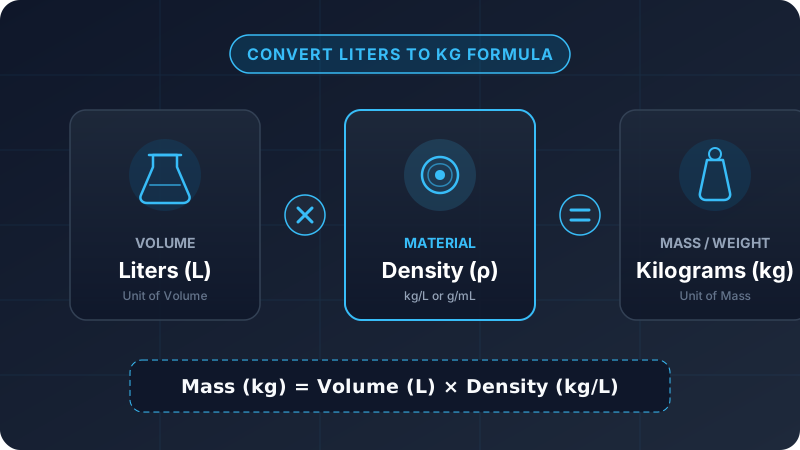
1 liter of Honey weighs approximately 1.42 kilograms (or 1420 grams) at standard room temperature. Because mass equals volume multiplied by density (\(m = V \times \rho\)), multiplying volume in liters by 1.42 gives the exact mass in kg.
Honey has a density of 1.42 kg/L, which makes it 42% heavier than water. Honey is roughly 80% sugar and under 20% water, which makes it about 42% denser than water. One litre weighs 1.42 kg, and a 1 kg jar is only about 0.7 litres of honey.
Beekeepers filling and pricing jars, bakers swapping honey for sugar, and shops that buy bulk honey by weight but sell by volume.
Moisture is the main driver: honey at 17% water is about 1.44 kg/L while 20% water drops it near 1.41. Warm honey is thinner and slightly less dense.
Natural bee honey is a remarkably dense, viscous, supersaturated sugar solution produced by honeybees from floral nectars. Its specific gravity averages approximately 1.420, giving it a nominal density of 1.420 kg/L (1,420 kg/m³ or 11.85 lb/US gal) at 20°C (68°F). Honey consists of approximately 80% to 82% carbohydrates (predominantly simple monosaccharides: ~38% fructose and ~31% glucose, with lesser fractions of maltose, sucrose, and complex oligosaccharides) dissolved in roughly 16% to 18% water. Because carbohydrate molecules form compact hydrogen-bonded networks, honey is approximately 42% denser than water and significantly heavier than culinary oils or dairy.
Water content (moisture percentage) is the single most critical determinant of honey density, commercial grade, and shelf-life stability. Under Codex Alimentarius and USDA honey standards, premium table honey must contain no more than 18.6% moisture (and no more than 20% for general grade honey). Drier honey with 15% moisture has a high density of approximately 1.435 kg/L and a refractive index exceeding 1.498, resisting crystallization and microbial spoilage. Conversely, high-moisture honey (>20% water) drops in density toward 1.405 kg/L and carries an acute risk of fermentation triggered by osmophilic yeasts (Zygosaccharomyces).
A widespread dilemma among commercial apiaries and artisanal beekeepers is the discrepancy between jar volume and honey label weight. Glass and PET containers are manufactured and specified by fluid volume (such as fluid ounces or milliliters), whereas global consumer protection regulations mandate that honey must be labeled and sold by net mass (grams or pounds). A standard 500 mL glass jar holds approximately 710 grams (1.57 lbs) of honey, meaning a beekeeper ordering 500 mL jars needs to pack over 70% more weight than water into the same container.
Practical reference weights for honey across standard commercial packaging and household containers.
| Container / Volume | Volume (L) | Weight (kg) | Weight (lb) | Primary Application |
|---|---|---|---|---|
| 1 Tablespoon (15 mL) | 0.015 L | 0.021 kg | 0.047 lb | Daily tea, coffee & culinary sweetener portion |
| 250 mL (Metric Cup) | 0.25 L | 0.355 kg | 0.783 lb | Standard baking & commercial confectionery cup |
| 375 mL / 12 fl oz Jar | 0.375 L | 0.533 kg | 1.174 lb | Classic queenline retail honey jar size |
| 500 mL Jar | 0.5 L | 0.710 kg | 1.565 lb | Most popular international beekeeper glass jar size |
| 1 Litre | 1 L | 1.420 kg | 3.131 lb | Base metric volume unit for culinary recipe bulk conversions |
| 5-Litre Food Pail | 5 L | 7.100 kg | 15.653 lb | Commercial bakery & confectionery food-service bucket |
| 20-Litre (5 Gal) Honey Bucket | 20 L | 28.400 kg | 62.611 lb | Apiary harvest bucket with gate valve (requires 2-person lift) |
| 205-Litre (55 Gal) Drum | 205 L | 291.100 kg | 641.770 lb | International bulk honey export steel drum |
Thermal expansion causes honey to expand as temperature increases, reducing weight per litre.
| Temperature | Density (kg/L) | Weight of 1 Litre | Metrology / Operating Conditions |
|---|---|---|---|
| 15°C (Cellar / Cold Honey) | 1.425 kg/L | 1.425 kg | Thick, semi-crystallized state with very high kinematic viscosity |
| 20°C (Standard Room Temp) | 1.420 kg/L | 1.420 kg | Official Codex Alimentarius & USDA bench testing baseline |
| 35°C (Hive Core Temperature) | 1.411 kg/L | 1.411 kg | Natural brood nest temperature where honey flows freely for extraction |
| 45°C (Gentle Liquefaction) | 1.404 kg/L | 1.404 kg | Safe warming decrystallization temperature preserving delicate enzymes |
| 60°C (Industrial Pumping) | 1.395 kg/L | 1.395 kg | Commercial filtering and flash heating temperature |
Type the volume in litres. The calculator is preset to Honey at 1.42 kg/L.
Flip to kilograms → litres to find how much space a given weight of honey takes up.
See kilograms, pounds, millilitres and gallons. Each litre adds 1.42 kg.
Honey is roughly 80% sugar and under 20% water, which makes it about 42% denser than water. One litre weighs 1.42 kg, and a 1 kg jar is only about 0.7 litres of honey. To convert, multiply the volume in litres by 1.42. To go the other way, divide the weight in kilograms by 1.42.
kg = Litres × 1.42
L  = kg ÷ 1.42

1 L   → 1.42 kg
10 L  → 14.2 kg
100 L → 142 kgConvert 5 litres of honey to kilograms: 5 × 1.42 = 7.1 kg, or 15.65 lb. Reversed: 7.1 kg ÷ 1.42 = 5 L.
| Scenario | Calculation | Result |
|---|---|---|
| 1 L of honey | 1 × 1.42 kg/L | 1.42 kg |
| 5 L of honey | 5 × 1.42 kg/L | 7.1 kg |
| 20 L of honey | 20 × 1.42 kg/L | 28.4 kg |
| 100 L of honey | 100 × 1.42 kg/L | 142 kg |
| 10 kg of honey (reverse) | 10 ÷ 1.42 kg/L | 7.04 L |
| Litres | Kilograms | Pounds | US gallons |
|---|---|---|---|
| 0.25 L | 0.355 kg | 0.78 lb | 0.07 gal |
| 0.5 L | 0.71 kg | 1.57 lb | 0.13 gal |
| 1 L | 1.42 kg | 3.13 lb | 0.26 gal |
| 2 L | 2.84 kg | 6.26 lb | 0.53 gal |
| 5 L | 7.1 kg | 15.65 lb | 1.32 gal |
| 10 L | 14.2 kg | 31.31 lb | 2.64 gal |
| 20 L | 28.4 kg | 62.61 lb | 5.28 gal |
| 50 L | 71 kg | 156.53 lb | 13.21 gal |
| 100 L | 142 kg | 313.06 lb | 26.42 gal |
Compare the weights of petrol, diesel, jet A-1, kerosene, and LPG per litre and gallon in kg and lbs. Includes fuel density tables and tank calculations.
Read articleDiscover how much water weighs across common volumes including liters, gallons, cubic meters, cups, and pints in both kilograms and pounds.
Read articleHow many grams in a cup? A chart for flour, sugar, rice, oats, milk, honey, oil, butter and 12 more ingredients, with tablespoon and ml equivalents and the reason cups are unreliable.
Read article1 kg ÷ 1.42 kg/L ≈ 0.704 litres (704 mL).
About 710 g of honey. Most jars labelled 500 g actually hold around 350 mL.
Honey is a supersaturated solution of approximately 80% natural sugars (fructose and glucose) and only 17% water. The dense carbohydrate molecules pack tightly, resulting in a density of 1.42 kg/L.
Yes. While thermal expansion in honey is subtle, warming honey from 15°C to 45°C lowers its density from 1.425 kg/L to roughly 1.404 kg/L and drastically reduces viscosity for pouring.
1 liter of honey weighs 1.42 kg (1,420 grams).
1 litre of honey weighs 1.42 kg (1420 grams, or 3.13 lb), using a density of 1.42 kg/L.
1 kg of honey is 0.704 litres. Divide the weight by the density: 1 ÷ 1.42 = 0.704.
Multiply the volume by 1.42. For example, 10 litres of honey is 14.2 kg and 50 litres is 71 kg.
Never guess a measurement again. Download our free PDF cheat sheet covering litres, kilograms, cups, and grams for over 50 common kitchen ingredients.