How Much Does Fuel Weigh? Petrol, Diesel, Jet Fuel & LPG Guide
Compare the weights of petrol, diesel, jet A-1, kerosene, and LPG per litre and gallon in kg and lbs. Includes fuel density tables and tank calculations.
Read articleOlive Oil weighs 0.91 kg per litre. Convert litres to kilograms (and back) using its exact density.
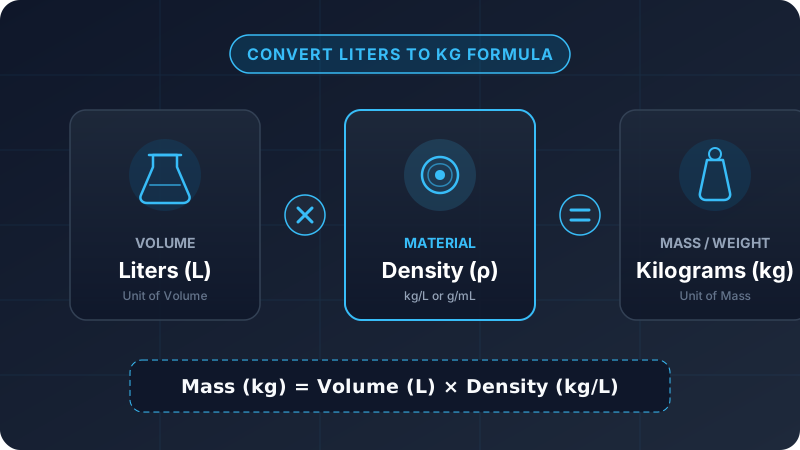
1 liter of Olive Oil weighs approximately 0.91 kilograms (or 910 grams) at standard room temperature. Because mass equals volume multiplied by density (\(m = V \times \rho\)), multiplying volume in liters by 0.91 gives the exact mass in kg.
Olive Oil has a density of 0.91 kg/L, which makes it 9% lighter than water. Olive oil is almost entirely triglycerides, which pack less tightly than water molecules, giving 0.91 kg/L. A litre of olive oil is therefore around 90 g lighter than a litre of water.
Olive pressers pricing by weight, restaurants buying 5-litre tins, exporters calculating shipping weight, and recipe conversions between ml and grams.
Density runs from about 0.910 to 0.916 kg/L depending on fatty-acid profile and temperature. Cold olive oil is denser than warm.
Extra Virgin Olive Oil (EVOO) is a natural lipid extract obtained entirely from the fruit of Olea europaea via mechanical cold pressing. Chemically, it consists of 98% to 99% mixed triglycerides, predominantly esters of the monounsaturated omega-9 fatty acid oleic acid (18:1, ~70%–80%), along with smaller fractions of linoleic and palmitic acids. Because long-chain aliphatic fatty acid tails possess significant steric volume and pack with less molecular cohesion than polarized water molecules, pure olive oil has a nominal density of 0.910 kg/L to 0.916 kg/L (averaging 0.910 kg/L or 7.594 lb/US gal) at 20°C (68°F), rendering it approximately 9% lighter than water.
Temperature changes exert a marked physical and visual effect on olive oil density and viscosity. Olive oil has a volumetric thermal expansion coefficient of approximately 0.00072 per °C. When chilled below 10°C (50°F), saturated palmitic and stearic triglyceride fractions crystallize into cloudy solid spheres (often termed 'olive butter'), increasing density toward 0.920 kg/L. When gently warmed in culinary kitchens to 30°C–40°C, the viscosity plummets and density declines toward 0.898 kg/L, meaning warm cooking oil occupies more volume than cold oil from the pantry.
In Mediterranean export commerce governed by the International Olive Council (IOC), commercial trading between olive oil mills, brokers, and packaging plants is conducted strictly in metric tonnes or kilograms using certified weigh-bridges. However, retail consumers buy olive oil in bottles and tins calibrated in milliliters (500 mL, 750 mL, or 1 L) or fluid ounces. In commercial bakery and restaurant recipe formulation, weighing olive oil on a digital scale (where 1 L = 910 g, or 100 mL = 91 g) is substantially faster and more precise than volumetric pouring, eliminating residue loss on measuring cups.
Practical reference weights for olive oil across standard commercial packaging and household containers.
| Container / Volume | Volume (L) | Weight (kg) | Weight (lb) | Primary Application |
|---|---|---|---|---|
| 1 Tablespoon (15 mL) | 0.015 L | 0.014 kg | 0.030 lb | Standard salad dressing & sautéing portion |
| 100 mL Bottle | 0.1 L | 0.091 kg | 0.201 lb | Gourmet artisan tasting sample bottle |
| 250 mL (Metric Cup) | 0.25 L | 0.228 kg | 0.502 lb | Artisan condiment bottle & baking cup recipe measure |
| 500 mL Bottle | 0.5 L | 0.455 kg | 1.003 lb | Standard consumer dark glass retail bottle |
| 750 mL Bottle | 0.75 L | 0.683 kg | 1.505 lb | Standard premium Extra Virgin Olive Oil bottle |
| 1 Litre | 1 L | 0.910 kg | 2.006 lb | Everyday culinary grocery bottle |
| 3 Litres | 3 L | 2.730 kg | 6.019 lb | Family pantry tin & food-service canister |
| 5-Litre Tin | 5 L | 4.550 kg | 10.031 lb | Standard Mediterranean export retail and restaurant tin |
| 205-Litre (55 Gal) Drum | 205 L | 186.55 kg | 411.27 lb | Commercial food manufacturer & cosmetics oil drum |
Thermal expansion causes olive oil to expand as temperature increases, reducing weight per litre.
| Temperature | Density (kg/L) | Weight of 1 Litre | Metrology / Operating Conditions |
|---|---|---|---|
| 5°C (Chilled Storage) | 0.921 kg/L | 0.921 kg | Cloudy semi-solid state; saturated triglycerides crystallize out |
| 15°C (IOC Testing Standard) | 0.914 kg/L | 0.914 kg | International Olive Council official laboratory benchmarking |
| 20°C (Standard Room Temp) | 0.910 kg/L | 0.910 kg | Standard ambient kitchen and grocery store shelf benchmark |
| 30°C (Warm Kitchen) | 0.903 kg/L | 0.903 kg | Hot summer day or commercial kitchen prep line |
| 50°C (Warmed Cooking Oil) | 0.889 kg/L | 0.889 kg | Preheated culinary and frying preparation |
Type the volume in litres. The calculator is preset to Olive Oil at 0.91 kg/L.
Flip to kilograms → litres to find how much space a given weight of olive oil takes up.
See kilograms, pounds, millilitres and gallons. Each litre adds 0.91 kg.
Olive oil is almost entirely triglycerides, which pack less tightly than water molecules, giving 0.91 kg/L. A litre of olive oil is therefore around 90 g lighter than a litre of water. To convert, multiply the volume in litres by 0.91. To go the other way, divide the weight in kilograms by 0.91.
kg = Litres × 0.91
L  = kg ÷ 0.91

1 L   → 0.91 kg
10 L  → 9.1 kg
100 L → 91 kgConvert 5 litres of olive oil to kilograms: 5 × 0.91 = 4.55 kg, or 10.03 lb. Reversed: 4.55 kg ÷ 0.91 = 5 L.
| Scenario | Calculation | Result |
|---|---|---|
| 1 L of olive oil | 1 × 0.91 kg/L | 0.91 kg |
| 5 L of olive oil | 5 × 0.91 kg/L | 4.55 kg |
| 20 L of olive oil | 20 × 0.91 kg/L | 18.2 kg |
| 100 L of olive oil | 100 × 0.91 kg/L | 91 kg |
| 10 kg of olive oil (reverse) | 10 ÷ 0.91 kg/L | 10.99 L |
| Litres | Kilograms | Pounds | US gallons |
|---|---|---|---|
| 0.25 L | 0.228 kg | 0.5 lb | 0.07 gal |
| 0.5 L | 0.455 kg | 1 lb | 0.13 gal |
| 1 L | 0.91 kg | 2.01 lb | 0.26 gal |
| 2 L | 1.82 kg | 4.01 lb | 0.53 gal |
| 5 L | 4.55 kg | 10.03 lb | 1.32 gal |
| 10 L | 9.1 kg | 20.06 lb | 2.64 gal |
| 20 L | 18.2 kg | 40.12 lb | 5.28 gal |
| 50 L | 45.5 kg | 100.31 lb | 13.21 gal |
| 100 L | 91 kg | 200.62 lb | 26.42 gal |
Compare the weights of petrol, diesel, jet A-1, kerosene, and LPG per litre and gallon in kg and lbs. Includes fuel density tables and tank calculations.
Read articleDiscover how much water weighs across common volumes including liters, gallons, cubic meters, cups, and pints in both kilograms and pounds.
Read articleHow many grams in a cup? A chart for flour, sugar, rice, oats, milk, honey, oil, butter and 12 more ingredients, with tablespoon and ml equivalents and the reason cups are unreliable.
Read articleAbout 1.10 litres (1,099 mL).
A 15 mL tablespoon of olive oil weighs about 13.7 g at 0.91 kg/L.
Because olive oil has a density of 0.910 kg/L, which is about 9% lighter than pure water (1.000 kg/L). In any oil and water mixture, the lighter oil rises to the top.
Yes. When olive oil cools below 10°C, high-melting saturated triglycerides crystallize into solids, slightly increasing density toward 0.920 kg/L.
1 liter of olive oil weighs approximately 0.91 kg.
1 litre of olive oil weighs 0.91 kg (910 grams, or 2.01 lb), using a density of 0.91 kg/L.
1 kg of olive oil is 1.099 litres. Divide the weight by the density: 1 ÷ 0.91 = 1.099.
Multiply the volume by 0.91. For example, 10 litres of olive oil is 9.1 kg and 50 litres is 45.5 kg.
Never guess a measurement again. Download our free PDF cheat sheet covering litres, kilograms, cups, and grams for over 50 common kitchen ingredients.