How Much Does Fuel Weigh? Petrol, Diesel, Jet Fuel & LPG Guide
Compare the weights of petrol, diesel, jet A-1, kerosene, and LPG per litre and gallon in kg and lbs. Includes fuel density tables and tank calculations.
Read articleWater (20°C Room Temp) weighs 0.998 kg per litre. Convert litres to kilograms (and back) using its exact density.
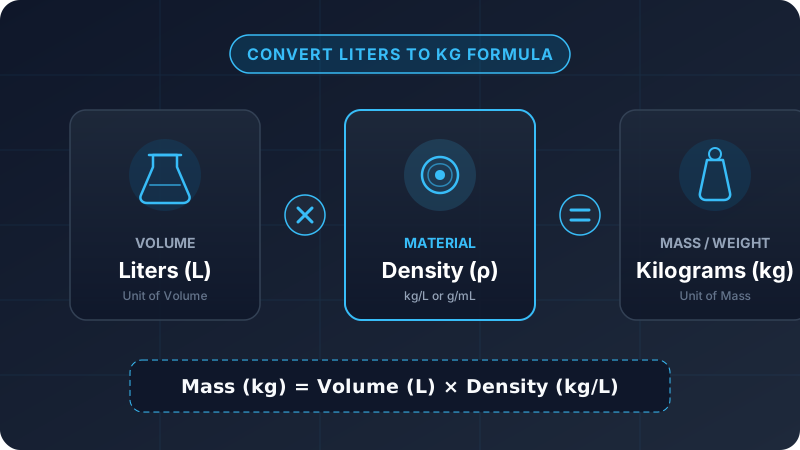
1 liter of Water (20°C Room Temp) weighs approximately 0.998 kilograms (or 998 grams) at standard room temperature. Because mass equals volume multiplied by density (\(m = V \times \rho\)), multiplying volume in liters by 0.998 gives the exact mass in kg.
Water (20°C Room Temp) has a density of 0.998 kg/L, which makes it essentially the same weight as water. Tap and bottled water is normally used around 20°C, where its density is 0.998 kg/L. The difference from 1.000 is only 0.2%, but it matters when you are scaling up to tonnes of water or doing laboratory-grade work.
Domestic cooking and baking measurements, filling kettles and boilers, plant-watering calculations and any situation where the water has been standing at room temperature.
Every 1°C of warming near room temperature lowers density by roughly 0.02%. Dissolved minerals in hard water push it back up very slightly, but not enough to matter outside a lab.
In everyday residential applications, room-temperature water (measured at 20°C / 68°F or 22°C / 72°F) is commonly approximated at exactly 1 kilogram per liter. However, in analytical chemistry, pharmaceutical preparation, and large-scale industrial compounding, this 0.18% difference is significant. One liter of distilled water at 20°C has an absolute density of 0.9982 kg/L (998.2 g/L). In a 50,000-liter municipal blending tank, this minor variance equates to an 90 kg discrepancy if calculated using the cold-water 1.000 kg/L baseline.
Hard water containing dissolved mineral salts (calcium carbonate, magnesium sulfates, and chlorides) exhibits a marginally higher density than demineralized laboratory water. Typical domestic tap water with 300 ppm total dissolved solids (TDS) has a density of roughly 0.9985 kg/L at 20°C. While negligible for kitchen cooking and domestic gardening, precision hydrometers and pycnometers must be zeroed with deionized water to prevent calibration errors.
When purchasing, handling, or transporting packaged water products in bulk, knowing the room-temperature mass helps accurately compute shipping freight costs. A standard pallet loaded with sixty 24-packs of 500 mL water bottles carries 720 liters of water, weighing 718.7 kg (1,584 lbs) net water mass, plus roughly 35 kg of PET bottles, corrugated cardboard trays, and wooden pallet base, totaling 754 kg (1,662 lbs) gross shipping weight.
Practical reference weights for water (20°c room temp) across standard commercial packaging and household containers.
| Container / Volume | Volume (L) | Weight (kg) | Weight (lb) | Primary Application |
|---|---|---|---|---|
| 100 mL | 0.1 L | 0.100 kg | 0.220 lb | Laboratory dosing & medical prescription reconstitution |
| 500 mL Bottle | 0.5 L | 0.499 kg | 1.100 lb | Standard commercial single-serve water bottle |
| 1 Litre | 1 L | 0.998 kg | 2.201 lb | Standard metric culinary jug & laboratory volumetric flask |
| 10 Litres | 10 L | 9.982 kg | 22.01 lb | Garden watering can & janitorial bucket |
| 19 Litres (5 US Gal Cooler Bottle) | 18.93 L | 18.89 kg | 41.65 lb | Standard commercial office water dispenser cooler jug |
| 1,000 Litres (1 m³) | 1000 L | 998.20 kg | 2,200.65 lb | Swimming pool filling & industrial chemical mixing tank |
Thermal expansion causes water (20°c room temp) to expand as temperature increases, reducing weight per litre.
| Temperature | Density (kg/L) | Weight of 1 Litre | Metrology / Operating Conditions |
|---|---|---|---|
| 15°C (Cool Tap Water) | 0.9991 kg/L | 0.9991 kg | Typical underground municipal water main supply temperature |
| 20°C (Standard Room Temp) | 0.9982 kg/L | 0.9982 kg | Standard laboratory testing reference and recipe baseline |
| 25°C (Warm Ambient) | 0.9970 kg/L | 0.9970 kg | Summer indoor ambient room temperature |
| 30°C (Tropical Ambient) | 0.9956 kg/L | 0.9956 kg | Unconditioned warehouse and warm climate storage condition |
Type the volume in litres. The calculator is preset to Water (20°C Room Temp) at 0.998 kg/L.
Flip to kilograms → litres to find how much space a given weight of water (20°c room temp) takes up.
See kilograms, pounds, millilitres and gallons. Each litre adds 0.998 kg.
Tap and bottled water is normally used around 20°C, where its density is 0.998 kg/L. The difference from 1.000 is only 0.2%, but it matters when you are scaling up to tonnes of water or doing laboratory-grade work. To convert, multiply the volume in litres by 0.998. To go the other way, divide the weight in kilograms by 0.998.
kg = Litres × 0.998
L  = kg ÷ 0.998

1 L   → 0.998 kg
10 L  → 9.98 kg
100 L → 99.8 kgConvert 5 litres of water (20°c room temp) to kilograms: 5 × 0.998 = 4.99 kg, or 11 lb. Reversed: 4.99 kg ÷ 0.998 = 5 L.
| Scenario | Calculation | Result |
|---|---|---|
| 1 L of water (20°c room temp) | 1 × 0.998 kg/L | 0.998 kg |
| 5 L of water (20°c room temp) | 5 × 0.998 kg/L | 4.99 kg |
| 20 L of water (20°c room temp) | 20 × 0.998 kg/L | 19.96 kg |
| 100 L of water (20°c room temp) | 100 × 0.998 kg/L | 99.8 kg |
| 10 kg of water (20°c room temp) (reverse) | 10 ÷ 0.998 kg/L | 10.02 L |
| Litres | Kilograms | Pounds | US gallons |
|---|---|---|---|
| 0.25 L | 0.249 kg | 0.55 lb | 0.07 gal |
| 0.5 L | 0.499 kg | 1.1 lb | 0.13 gal |
| 1 L | 0.998 kg | 2.2 lb | 0.26 gal |
| 2 L | 1.996 kg | 4.4 lb | 0.53 gal |
| 5 L | 4.99 kg | 11 lb | 1.32 gal |
| 10 L | 9.98 kg | 22 lb | 2.64 gal |
| 20 L | 19.96 kg | 44 lb | 5.28 gal |
| 50 L | 49.9 kg | 110.01 lb | 13.21 gal |
| 100 L | 99.8 kg | 220.02 lb | 26.42 gal |
Compare the weights of petrol, diesel, jet A-1, kerosene, and LPG per litre and gallon in kg and lbs. Includes fuel density tables and tank calculations.
Read articleDiscover how much water weighs across common volumes including liters, gallons, cubic meters, cups, and pints in both kilograms and pounds.
Read articleHow many grams in a cup? A chart for flour, sugar, rice, oats, milk, honey, oil, butter and 12 more ingredients, with tablespoon and ml equivalents and the reason cups are unreliable.
Read articleYes, by 2 grams: 1 litre at 20°C is 0.998 kg (998 g). For everyday cooking you can safely treat it as 1 kg.
1 m³ is 1,000 litres, so it weighs 998 kg at 20°C — just under one tonne.
As water warms from 4°C to 20°C, the thermal kinetic energy causes water molecules to vibrate more rapidly and spread slightly farther apart, expanding volume and decreasing density to 0.998 kg/L.
1 liter of water at 20°C weighs 0.998 kg (998 grams).
1 litre of water (20°c room temp) weighs 0.998 kg (998 grams, or 2.2 lb), using a density of 0.998 kg/L.
1 kg of water (20°c room temp) is 1.002 litres. Divide the weight by the density: 1 ÷ 0.998 = 1.002.
Multiply the volume by 0.998. For example, 10 litres of water (20°c room temp) is 9.98 kg and 50 litres is 49.9 kg.
Never guess a measurement again. Download our free PDF cheat sheet covering litres, kilograms, cups, and grams for over 50 common kitchen ingredients.