How Much Does Fuel Weigh? Petrol, Diesel, Jet Fuel & LPG Guide
Compare the weights of petrol, diesel, jet A-1, kerosene, and LPG per litre and gallon in kg and lbs. Includes fuel density tables and tank calculations.
Read articleDiesel Fuel weighs 0.835 kg per litre. Convert litres to kilograms (and back) using its exact density.
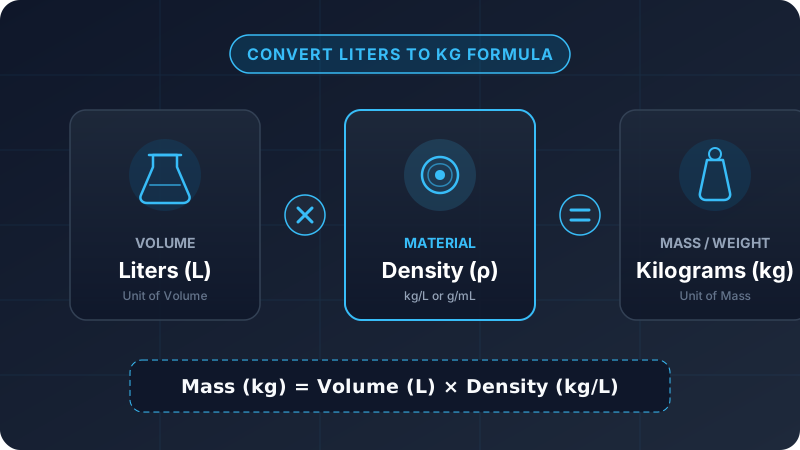
1 liter of Diesel Fuel weighs approximately 0.835 kilograms (or 835 grams) at standard room temperature. Because mass equals volume multiplied by density (\(m = V \times \rho\)), multiplying volume in liters by 0.835 gives the exact mass in kg.
Diesel Fuel has a density of 0.835 kg/L, which makes it 17% lighter than water. Diesel is made of longer hydrocarbon chains than petrol and is therefore denser, at 0.835 kg/L. It carries more energy per litre but also more weight.
Truck and generator tank loads, fleet fuel accounting, bunkering for boats, and carbon calculations based on kilograms of fuel burned.
Standard EN 590 diesel allows 0.820–0.845 kg/L at 15°C. Winter-grade diesel is lighter, and biodiesel blends are denser.
Automotive and industrial diesel fuel is an intricate middle-distillate blend composed primarily of saturated paraffins, naphthenes, and aromatic hydrocarbons ranging from C10 to C28. Under the European Standard EN 590 and American ASTM D975 specifications, commercial diesel fuel is legally required to maintain a density between 0.820 kg/L and 0.845 kg/L at 15°C (59°F), with a standard global market average of approximately 0.835 kg/L (835 kg/m³ or 6.968 lb/US gal). This makes diesel fuel approximately 12.8% denser than motor petrol/gasoline and 16.5% lighter than water.
Temperature changes exert a major influence on diesel volumetric density due to its volumetric thermal expansion coefficient of approximately 0.00083 to 0.00085 per °C. During summer heatwaves (35°C / 95°F), diesel expands significantly, lowering density to roughly 0.819 kg/L, meaning a full 500-liter truck tank delivers less mass and lower total thermal energy than in winter. In cold climates, refineries formulate 'winter-grade' diesel by adding lighter kerosene fractions (Jet A-1 / paraffinic diluents) to prevent wax crystal agglomeration and lower the Cold Filter Plugging Point (CFPP), which naturally shifts baseline density down to ~0.825 kg/L.
Commercial fleet operators, logistics companies, and maritime bunkering services rely heavily on liter-to-kilogram conversions because fuel is metered through pump nozzles in volumetric liters but traded internationally, taxed, and monitored in metric tonnes. A long-haul semi-truck carrying 800 liters in dual saddle tanks carries 668 kg (1,473 lbs) of diesel deadweight when full. Accurately tracking fuel mass is essential for preventing gross vehicle weight rating (GVWR) axle overloads and for ISO 14064 carbon emissions reporting, where CO2 output is calculated per kilogram of fuel combusted.
Practical reference weights for diesel fuel across standard commercial packaging and household containers.
| Container / Volume | Volume (L) | Weight (kg) | Weight (lb) | Primary Application |
|---|---|---|---|---|
| 1 Litre | 1 L | 0.835 kg | 1.841 lb | Standard fuel dispensing nozzle reference unit |
| 1 US Gallon | 3.785 L | 3.161 kg | 6.968 lb | US highway freight standard fueling metric |
| 10-Litre Emergency Can | 10 L | 8.350 kg | 18.409 lb | Portable spare fuel container for roadside rescue |
| 20-Litre NATO Jerry Can | 20 L | 16.700 kg | 36.817 lb | Heavy-duty tactical & agricultural fuel transport canister |
| 100-Litre Tank | 100 L | 83.500 kg | 184.086 lb | Agricultural tractor or commercial delivery van tank |
| 205-Litre (55 Gal) Drum | 205 L | 171.175 kg | 377.376 lb | Workshop lubricant & jobsite generator supply barrel |
| 400-Litre Truck Saddle Tank | 400 L | 334.000 kg | 736.344 lb | Class 8 heavy-duty long-haul highway tractor tank |
| 1,000-Litre IBC Tote | 1000 L | 835.000 kg | 1,840.860 lb | Commercial jobsite generator & farm bulk fuel storage |
Thermal expansion causes diesel fuel to expand as temperature increases, reducing weight per litre.
| Temperature | Density (kg/L) | Weight of 1 Litre | Metrology / Operating Conditions |
|---|---|---|---|
| -15°C (Extreme Winter) | 0.856 kg/L | 0.856 kg | Winter diesel with anti-waxing additives near cloud point |
| 0°C (Freezing Winter) | 0.846 kg/L | 0.846 kg | Cold morning tank temperature in temperate zones |
| 15°C (Standard Fiscal Ref) | 0.835 kg/L | 0.835 kg | Official ASTM D1250 petroleum measurement table standard |
| 25°C (Warm Ambient) | 0.827 kg/L | 0.827 kg | Typical summer underground service station storage temperature |
| 40°C (Extreme Summer) | 0.815 kg/L | 0.815 kg | Exposed rooftop day tanks and desert machinery operating bands |
Type the volume in litres. The calculator is preset to Diesel Fuel at 0.835 kg/L.
Flip to kilograms → litres to find how much space a given weight of diesel fuel takes up.
See kilograms, pounds, millilitres and gallons. Each litre adds 0.835 kg.
Diesel is made of longer hydrocarbon chains than petrol and is therefore denser, at 0.835 kg/L. It carries more energy per litre but also more weight. To convert, multiply the volume in litres by 0.835. To go the other way, divide the weight in kilograms by 0.835.
kg = Litres × 0.835
L  = kg ÷ 0.835

1 L   → 0.835 kg
10 L  → 8.35 kg
100 L → 83.5 kgConvert 5 litres of diesel fuel to kilograms: 5 × 0.835 = 4.175 kg, or 9.2 lb. Reversed: 4.175 kg ÷ 0.835 = 5 L.
| Scenario | Calculation | Result |
|---|---|---|
| 1 L of diesel fuel | 1 × 0.835 kg/L | 0.835 kg |
| 5 L of diesel fuel | 5 × 0.835 kg/L | 4.175 kg |
| 20 L of diesel fuel | 20 × 0.835 kg/L | 16.7 kg |
| 100 L of diesel fuel | 100 × 0.835 kg/L | 83.5 kg |
| 10 kg of diesel fuel (reverse) | 10 ÷ 0.835 kg/L | 11.98 L |
| Litres | Kilograms | Pounds | US gallons |
|---|---|---|---|
| 0.25 L | 0.209 kg | 0.46 lb | 0.07 gal |
| 0.5 L | 0.417 kg | 0.92 lb | 0.13 gal |
| 1 L | 0.835 kg | 1.84 lb | 0.26 gal |
| 2 L | 1.67 kg | 3.68 lb | 0.53 gal |
| 5 L | 4.175 kg | 9.2 lb | 1.32 gal |
| 10 L | 8.35 kg | 18.41 lb | 2.64 gal |
| 20 L | 16.7 kg | 36.82 lb | 5.28 gal |
| 50 L | 41.75 kg | 92.04 lb | 13.21 gal |
| 100 L | 83.5 kg | 184.09 lb | 26.42 gal |
Compare the weights of petrol, diesel, jet A-1, kerosene, and LPG per litre and gallon in kg and lbs. Includes fuel density tables and tank calculations.
Read articleDiscover how much water weighs across common volumes including liters, gallons, cubic meters, cups, and pints in both kilograms and pounds.
Read articleHow many grams in a cup? A chart for flour, sugar, rice, oats, milk, honey, oil, butter and 12 more ingredients, with tablespoon and ml equivalents and the reason cups are unreliable.
Read article100 × 0.835 = 83.5 kg.
Yes. A litre of diesel is about 0.835 kg against 0.74 kg for petrol, roughly 13% heavier.
205 liters of diesel weighs 171.2 kg (377.4 lbs) net fuel weight. Including the empty steel drum (~20 kg), gross weight is approximately 191 kg (421 lbs).
Like all petroleum liquids, diesel expands when heated and contracts when cooled. Its density shifts by roughly 0.00083 kg/L per 1°C temperature change, which is why bulk commercial fuel is metered at a standardized 15°C reference.
1 liter of diesel fuel weighs about 0.835 kg.
1 litre of diesel fuel weighs 0.835 kg (835 grams, or 1.84 lb), using a density of 0.835 kg/L.
1 kg of diesel fuel is 1.198 litres. Divide the weight by the density: 1 ÷ 0.835 = 1.198.
Multiply the volume by 0.835. For example, 10 litres of diesel fuel is 8.35 kg and 50 litres is 41.75 kg.
Never guess a measurement again. Download our free PDF cheat sheet covering litres, kilograms, cups, and grams for over 50 common kitchen ingredients.