How Much Does Fuel Weigh? Petrol, Diesel, Jet Fuel & LPG Guide
Compare the weights of petrol, diesel, jet A-1, kerosene, and LPG per litre and gallon in kg and lbs. Includes fuel density tables and tank calculations.
Read articleMilk (Whole) weighs 1.03 kg per litre. Convert litres to kilograms (and back) using its exact density.
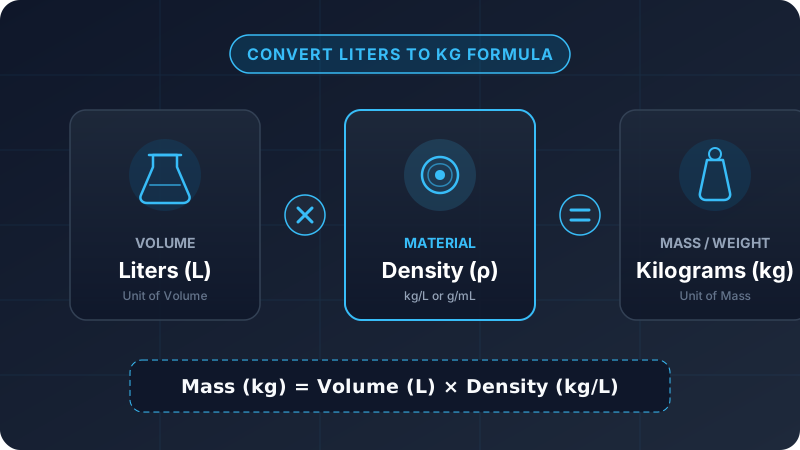
1 liter of Milk (Whole) weighs approximately 1.03 kilograms (or 1030 grams) at standard room temperature. Because mass equals volume multiplied by density (\(m = V \times \rho\)), multiplying volume in liters by 1.03 gives the exact mass in kg.
Milk (Whole) has a density of 1.03 kg/L, which makes it 3% heavier than water. Whole cow's milk is mostly water but carries lactose, protein and minerals that are denser than water, partly offset by the lighter fat globules. The net result is 1.03 kg/L, so a one-litre carton holds 1.03 kg of milk.
Dairy and café purchasing by weight, scaling recipes written in grams, tanker and churn capacity planning, and infant feeding calculations where weight is recorded.
Fat lowers density and solids-not-fat raise it. Most whole milk falls between 1.028 and 1.034 kg/L, and temperature shifts it by a small fraction of a percent.
Whole bovine cow's milk is an intricate biological colloidal emulsion of butterfat globules suspended within an aqueous phase containing dissolved lactose sugar, casein protein micelles, serum albumin, and vital minerals (calcium and phosphorus). Standard whole milk with 3.5% to 3.8% butterfat exhibits an average density of 1.030 kg/L (1,030 kg/m³ or 8.596 lb/US gal) at 15°C–20°C. While milk is approximately 87.5% water by volume, the dissolved solids-not-fat (SNF) portion possesses an intrinsic dry density of approximately 1.55 kg/L, pulling the overall liquid density distinctly above that of pure water.
The balance between butterfat and milk solids-not-fat governs density variations across commercial dairy categories. Butterfat is significantly lighter than water (density ~0.915–0.920 kg/L at room temperature). Consequently, removing fat during centrifugal separation actually increases the density of the remaining liquid: whole milk measures ~1.030 kg/L, semi-skimmed milk (2% fat) averages ~1.032 kg/L, and non-fat skim milk reaches 1.035 kg/L. When raw milk is chilled to refrigeration temperatures (4°C / 39°F), density rises to ~1.033 kg/L as lipid fractions solidify, whereas flash pasteurization pre-heating at 65°C thins the emulsion down to ~1.015 kg/L.
In commercial dairy operations, cheese making, and international dairy trading, mass measurement is the universal standard for legal and financial transactions. Dairy cooperatives collect raw milk from farms in bulk refrigerated road tankers equipped with certified load-cell weigh-bridges or Coriolis mass flow meters, paying producers strictly per kilogram of milk solids delivered. This prevents volume measurement discrepancies caused by entrapped air bubbles, agitation foam, and temperature expansion during pumping.
Practical reference weights for milk (whole) across standard commercial packaging and household containers.
| Container / Volume | Volume (L) | Weight (kg) | Weight (lb) | Primary Application |
|---|---|---|---|---|
| 250 mL (Metric Cup) | 0.25 L | 0.258 kg | 0.568 lb | Baking, pancake batter & culinary recipe cup |
| 500 mL Bottle / Pouch | 0.5 L | 0.515 kg | 1.135 lb | Convenience grocery pouch & single-serve school bottle |
| 1 Litre Carton | 1 L | 1.030 kg | 2.271 lb | Standard international consumer grocery milk carton |
| 2-Litre Jug | 2 L | 2.060 kg | 4.542 lb | Family grocery bottle & food service milk carton |
| 1 US Gallon (3.785 L) | 3.785 L | 3.899 kg | 8.596 lb | Standard US supermarket plastic milk jug |
| 10-Litre Dairy Bucket | 10 L | 10.30 kg | 22.71 lb | Artisan cheese curd batch & paneer coagulation vat |
| 20-Litre Milk Can | 20 L | 20.60 kg | 45.42 lb | Traditional stainless steel churn & farm collection vessel |
| 1,000-Litre Silo Tank | 1000 L | 1,030.00 kg | 2,270.76 lb | Commercial dairy processing holding silo & tanker compartment |
Thermal expansion causes milk (whole) to expand as temperature increases, reducing weight per litre.
| Temperature | Density (kg/L) | Weight of 1 Litre | Metrology / Operating Conditions |
|---|---|---|---|
| 4°C (Refrigerated Milk) | 1.033 kg/L | 1.033 kg | Standard farm cooling bulk tank and domestic refrigerator baseline |
| 15°C (European Dairy Standard) | 1.030 kg/L | 1.030 kg | Official lactometer testing and regulatory dairy calibration benchmark |
| 20°C (Standard Room Temp) | 1.028 kg/L | 1.028 kg | Ambient baking bench and culinary preparation temperature |
| 40°C (Fermentation Setting) | 1.022 kg/L | 1.022 kg | Yogurt culture inoculation and rennet cheese curd setting temperature |
| 65°C (Pasteurization Pre-heat) | 1.015 kg/L | 1.015 kg | High-temperature short-time (HTST) pasteurizer intake temperature |
Type the volume in litres. The calculator is preset to Milk (Whole) at 1.03 kg/L.
Flip to kilograms → litres to find how much space a given weight of milk (whole) takes up.
See kilograms, pounds, millilitres and gallons. Each litre adds 1.03 kg.
Whole cow's milk is mostly water but carries lactose, protein and minerals that are denser than water, partly offset by the lighter fat globules. The net result is 1.03 kg/L, so a one-litre carton holds 1.03 kg of milk. To convert, multiply the volume in litres by 1.03. To go the other way, divide the weight in kilograms by 1.03.
kg = Litres × 1.03
L  = kg ÷ 1.03

1 L   → 1.03 kg
10 L  → 10.3 kg
100 L → 103 kgConvert 5 litres of milk (whole) to kilograms: 5 × 1.03 = 5.15 kg, or 11.35 lb. Reversed: 5.15 kg ÷ 1.03 = 5 L.
| Scenario | Calculation | Result |
|---|---|---|
| 1 L of milk (whole) | 1 × 1.03 kg/L | 1.03 kg |
| 5 L of milk (whole) | 5 × 1.03 kg/L | 5.15 kg |
| 20 L of milk (whole) | 20 × 1.03 kg/L | 20.6 kg |
| 100 L of milk (whole) | 100 × 1.03 kg/L | 103 kg |
| 10 kg of milk (whole) (reverse) | 10 ÷ 1.03 kg/L | 9.71 L |
| Litres | Kilograms | Pounds | US gallons |
|---|---|---|---|
| 0.25 L | 0.258 kg | 0.57 lb | 0.07 gal |
| 0.5 L | 0.515 kg | 1.14 lb | 0.13 gal |
| 1 L | 1.03 kg | 2.27 lb | 0.26 gal |
| 2 L | 2.06 kg | 4.54 lb | 0.53 gal |
| 5 L | 5.15 kg | 11.35 lb | 1.32 gal |
| 10 L | 10.3 kg | 22.71 lb | 2.64 gal |
| 20 L | 20.6 kg | 45.42 lb | 5.28 gal |
| 50 L | 51.5 kg | 113.54 lb | 13.21 gal |
| 100 L | 103 kg | 227.08 lb | 26.42 gal |
Compare the weights of petrol, diesel, jet A-1, kerosene, and LPG per litre and gallon in kg and lbs. Includes fuel density tables and tank calculations.
Read articleDiscover how much water weighs across common volumes including liters, gallons, cubic meters, cups, and pints in both kilograms and pounds.
Read articleHow many grams in a cup? A chart for flour, sugar, rice, oats, milk, honey, oil, butter and 12 more ingredients, with tablespoon and ml equivalents and the reason cups are unreliable.
Read articleAbout 0.97 litres (970 mL). Divide 1 kg by 1.03 kg/L to get the volume.
Because milk is paid for and processed by its fat and protein content, which is a share of mass. Weighing avoids errors from foam, temperature and the density changes between batches.
Yes. Skim milk has a density of 1.035 kg/L compared to 1.030 kg/L for whole milk, because removing lighter butterfat leaves a higher concentration of dense proteins and minerals.
One US gallon of whole milk (3.785 liters) weighs approximately 3.90 kg (8.60 lbs). One Imperial gallon (4.546 liters) weighs 4.68 kg (10.32 lbs).
1 liter of whole milk weighs approximately 1.03 kg. 5 liters of milk weigh 5.15 kg.
Yes. While 1 liter of water weighs 1.00 kg, 1 liter of milk weighs 1.03 kg due to dissolved milk solids.
1 litre of milk (whole) weighs 1.03 kg (1030 grams, or 2.27 lb), using a density of 1.03 kg/L.
1 kg of milk (whole) is 0.971 litres. Divide the weight by the density: 1 ÷ 1.03 = 0.971.
Multiply the volume by 1.03. For example, 10 litres of milk (whole) is 10.3 kg and 50 litres is 51.5 kg.
Never guess a measurement again. Download our free PDF cheat sheet covering litres, kilograms, cups, and grams for over 50 common kitchen ingredients.