How Much Does Fuel Weigh? Petrol, Diesel, Jet Fuel & LPG Guide
Compare the weights of petrol, diesel, jet A-1, kerosene, and LPG per litre and gallon in kg and lbs. Includes fuel density tables and tank calculations.
Read articleHydrogen Peroxide (30%) weighs 1.11 kg per litre. Convert litres to kilograms (and back) using its exact density.
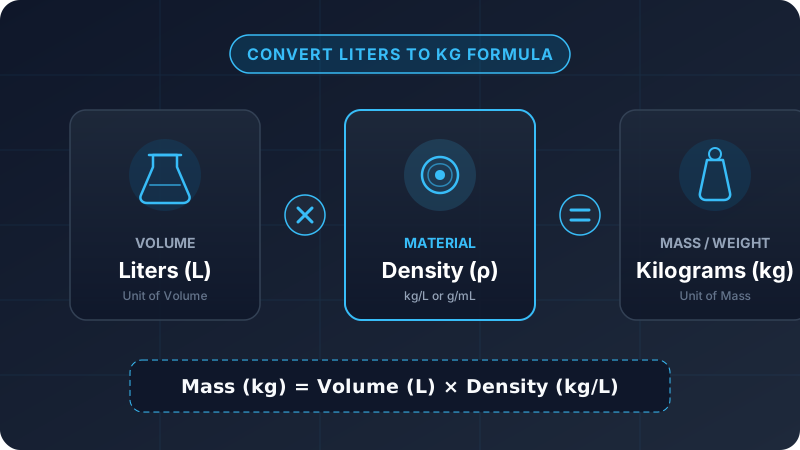
1 liter of Hydrogen Peroxide (30%) weighs approximately 1.11 kilograms (or 1110 grams) at standard room temperature. Because mass equals volume multiplied by density (\(m = V \times \rho\)), multiplying volume in liters by 1.11 gives the exact mass in kg.
Hydrogen Peroxide (30%) has a density of 1.11 kg/L, which makes it 11% heavier than water. Commercial 30% hydrogen peroxide is a water solution with a density of about 1.11 kg/L, roughly 11% heavier than water.
Bleaching, disinfection, rocket-propellant research and water treatment. Concentrated peroxide is an oxidiser that needs careful handling.
Concentration is the whole story: 3% pharmacy peroxide is about 1.01 kg/L, 30% is ~1.11, 50% is ~1.20, 90% is ~1.39 and pure H₂O₂ is ~1.45. Always confirm your grade.
Type the volume in litres. The calculator is preset to Hydrogen Peroxide (30%) at 1.11 kg/L.
Flip to kilograms → litres to find how much space a given weight of hydrogen peroxide (30%) takes up.
See kilograms, pounds, millilitres and gallons. Each litre adds 1.11 kg.
Commercial 30% hydrogen peroxide is a water solution with a density of about 1.11 kg/L, roughly 11% heavier than water. To convert, multiply the volume in litres by 1.11. To go the other way, divide the weight in kilograms by 1.11.
kg = Litres × 1.11
L  = kg ÷ 1.11

1 L   → 1.11 kg
10 L  → 11.1 kg
100 L → 111 kgConvert 5 litres of hydrogen peroxide (30%) to kilograms: 5 × 1.11 = 5.55 kg, or 12.24 lb. Reversed: 5.55 kg ÷ 1.11 = 5 L.
| Scenario | Calculation | Result |
|---|---|---|
| 1 L of hydrogen peroxide (30%) | 1 × 1.11 kg/L | 1.11 kg |
| 5 L of hydrogen peroxide (30%) | 5 × 1.11 kg/L | 5.55 kg |
| 20 L of hydrogen peroxide (30%) | 20 × 1.11 kg/L | 22.2 kg |
| 100 L of hydrogen peroxide (30%) | 100 × 1.11 kg/L | 111 kg |
| 10 kg of hydrogen peroxide (30%) (reverse) | 10 ÷ 1.11 kg/L | 9.01 L |
| Litres | Kilograms | Pounds | US gallons |
|---|---|---|---|
| 0.25 L | 0.278 kg | 0.61 lb | 0.07 gal |
| 0.5 L | 0.555 kg | 1.22 lb | 0.13 gal |
| 1 L | 1.11 kg | 2.45 lb | 0.26 gal |
| 2 L | 2.22 kg | 4.89 lb | 0.53 gal |
| 5 L | 5.55 kg | 12.24 lb | 1.32 gal |
| 10 L | 11.1 kg | 24.47 lb | 2.64 gal |
| 20 L | 22.2 kg | 48.94 lb | 5.28 gal |
| 50 L | 55.5 kg | 122.36 lb | 13.21 gal |
| 100 L | 111 kg | 244.71 lb | 26.42 gal |
Compare the weights of petrol, diesel, jet A-1, kerosene, and LPG per litre and gallon in kg and lbs. Includes fuel density tables and tank calculations.
Read articleDiscover how much water weighs across common volumes including liters, gallons, cubic meters, cups, and pints in both kilograms and pounds.
Read articleHow many grams in a cup? A chart for flour, sugar, rice, oats, milk, honey, oil, butter and 12 more ingredients, with tablespoon and ml equivalents and the reason cups are unreliable.
Read articleYes. This page uses 1.11 kg/L for 30% solution. A 3% pharmacy bottle is about 1.01 kg/L and a 90% rocket-grade solution is about 1.39 kg/L.
5 × 1.11 = 5.55 kg.
1 litre of hydrogen peroxide (30%) weighs 1.11 kg (1110 grams, or 2.45 lb), using a density of 1.11 kg/L.
1 kg of hydrogen peroxide (30%) is 0.901 litres. Divide the weight by the density: 1 ÷ 1.11 = 0.901.
Multiply the volume by 1.11. For example, 10 litres of hydrogen peroxide (30%) is 11.1 kg and 50 litres is 55.5 kg.
Never guess a measurement again. Download our free PDF cheat sheet covering litres, kilograms, cups, and grams for over 50 common kitchen ingredients.